Microgravity research
Studying protein crystals, biological systems and materials to understand how they behave in microgravity.
A new space economy is taking shape. And it needs a way to bring its value home.
Understand Our Tech ↓Space is becoming more than a place to deploy satellites. It is opening up new possibilities for scientific research, technology development and manufacturing.
On Earth, gravity influences almost everything around us. It affects how fluids flow, how particles settle, how crystals form and how living systems develop. In orbit, objects and experiments experience microgravity: a condition of continuous free fall in which the effects of gravity are greatly reduced (not zero, but approximately one-millionth of what it is on the Earth’s surface).
Without the usual influence of gravity, certain physical, chemical and biological processes unfold differently. A microgravity environment removes convection, sedimentation and buoyancy, all of which disrupt physical and chemical processes under Earth gravity.
This is useful to investigate phenomena that are difficult to study under Earth’s conditions and to explore new ways of producing advanced materials. Research on the International Space Station and other orbiting capsules has shown that microgravity can assist the development of next-generation materials in fields like space, medicine and communications.
Studying protein crystals, biological systems and materials to understand how they behave in microgravity.
Exploring the production of advanced materials such as ZBLAN optical fibre and semiconductor crystals, where microgravity can influence how materials form.
Investigating how microgravity may support the development of complex biological structures, including engineered tissues and artificial retinal models.
Putting spacecraft components, instruments and other hardware through real space conditions, then bringing them back to Earth for inspection and further development.
Getting to space creates new possibilities. But for research, experimentation and manufacturing in orbit to deliver value on Earth, we need to bring the results back.
Samples need to be analysed. Materials need to be evaluated. Hardware needs to be inspected. And that means return must become an integral part of the mission.
Returning from orbit is a complex engineering challenge. A spacecraft must withstand the heat of re-entry, maintain control as it moves through the atmosphere and recover its payload safely. We are developing a reusable lifting-body spacecraft designed to address these challenges through an integrated approach to re-entry and recovery.
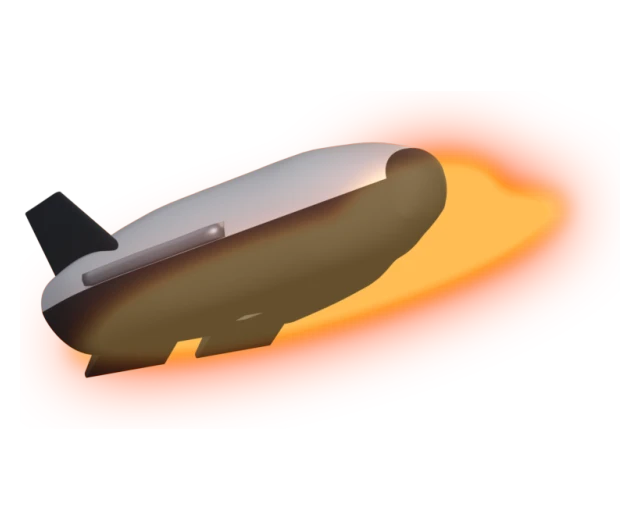
As the spacecraft enters the atmosphere, aerodynamic heating exposes it to extreme temperatures. Thermal protection helps shield the vehicle and its payload.
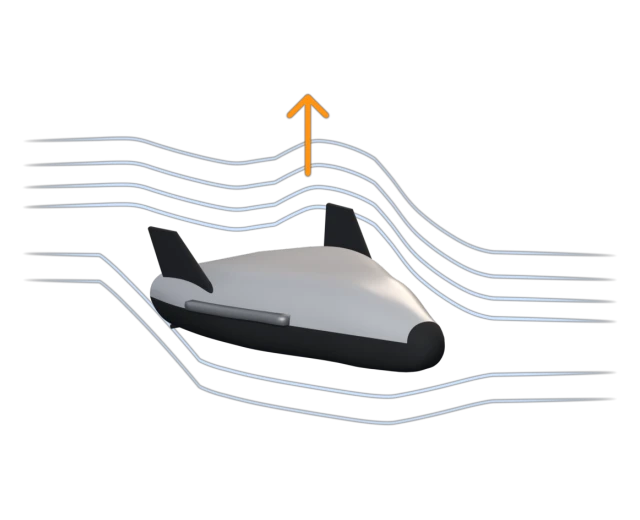
Stage 01 · Re-entryA lifting body uses the shape of the spacecraft itself to generate aerodynamic lift, helping guide its flight through the atmosphere.
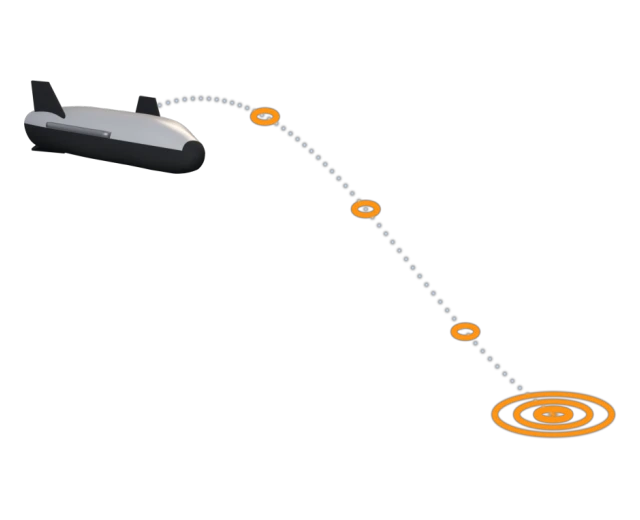
Stage 02 · LiftGuidance and control systems help the spacecraft follow its intended trajectory and manage its descent.
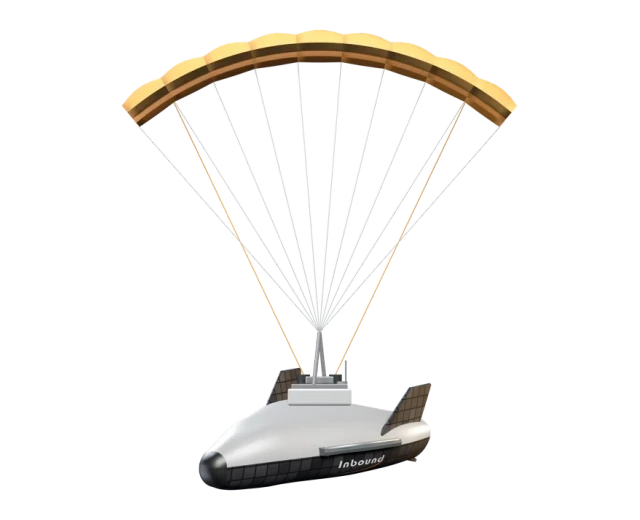
Stage 03 · GuidanceIn the final stage, a guided ram-air parafoil enables controlled gliding descent towards the designated recovery area.
Stage 04 · RecoveryMore accessible and repeatable return capability could change how researchers, manufacturers and technology developers plan activities in orbit.
Instead of treating the return journey as an occasional constraint, it could become an integral part of the space-based research and manufacturing process.
Longer-duration experiments and returned samples for further study.
Exploring research and future manufacturing opportunities in orbit.
Testing, recovering and evaluating hardware developed for space.
Supporting stations, orbital platforms and a growing ecosystem of space-based activity.
We’re developing the spacecraft technologies to make payload return a more accessible part of the orbital mission.
Discuss a mission with us →